
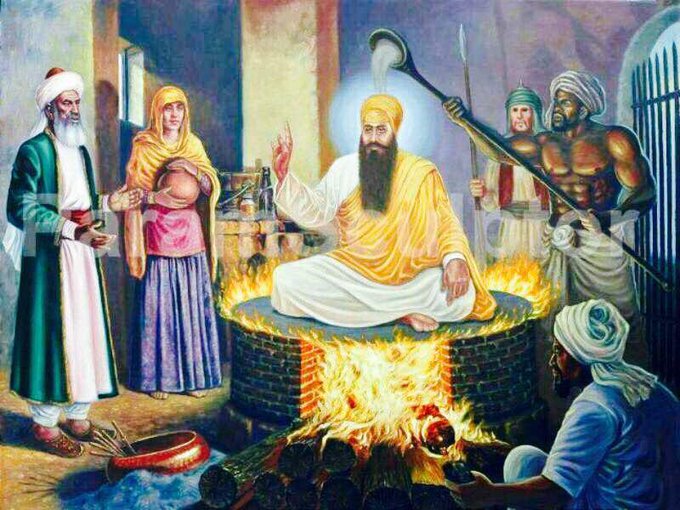
SHADWAL WEB DESK: Born on 15 April 1563 to Guru Ramdas and Bibi Bhani, Arjan Dev was chosen by his father as his successor even though he was the youngest son. Guru Arjan Dev, the fifth guru of Sikh, was the first of the two gurus to be martyred in the Sikh faith. He is known for compiling the first copy of the Sikh scripture called Adi Granth, now known as Guru Granth Sahib. It is a compilation of the hymns composed by Guru Nanak and 32 other Hindu and Muslim saints including more than 2,000 hymns that he composed himself. This included works of Sheikh Farid, Bhagat Kabir, Bhagat Ravi Das, Dhanna Namdev, Ramannand, Jai Dev, Trilochan, Beni, Pipa, and Surdas. The Adi Granth was later declared as the ultimate Guru Bani or word of god by Guru Gobind Singh. He added 115 hymns composed by Guru Tegh Bahadur in the second rendition and the Adi Granth became the Guru Granth Sahib.
First Guru to be born in the Sikh family, he conceived of and began the construction of Harmandir Sahib, or the Golden Temple, in Amritsar. Arjan Dev wanted Harmandir Sahib to stand for inclusivity, a place where everyone was welcome. The guru also invited the renowned Muslim saint Mia Mir to lay the foundation stone of the temple. Instead of making the temple a towering elevated monument, he decided to place it at a lower elevation as a symbolic gesture, so that one would feel humble upon entering the temple.
In the year 1606, he was captured by Mughal Emperor Jahangir and was imprisoned in Lahore Fort due to his increasing influence in Northern India and the fast spread of Sikhism. It is also believed that Guru also blessed Jahangir’s rebellious son Khusrau. It is also said that his conversions to Sikhism threatened the orthodox Muslim clergy and Hindu elite.
After arresting the guru, Jahangir asked him to convert to Islam but he refused. He even fined the guru with Rs 2 lakh plus elimination of all text from the Adi Granth that the Mughal emperor found ‘offensive’ to Hindu or Muslims. But again he refused. So, Jahangir condemned him to be tortured to death. Famously, the guru was made to sit in a burning hot plate and hot sand was poured on his face. It is said that when he was allowed to take a bath in River Ravi on May 30, 1606, he never returned. It is now the exact place where Gurudwara Dera Sahib in Lahore stands.
In the history of Sikhism, his martyrdom is considered as a watershed event. When Guru Hargobind took the throne, he was the first Sikh guru to deviate from the poet-guru tradition established since Guru Nanak. Armed with two swords dangling by his waist, Hargobind changed the identity of the Sikh guru who was here to save the Sikhs from oppression by the Mughals. The sacrifice of Guru Arjan Dev was looked at as a sacrifice for the truth, and it became un-Sikh like to stand oppression. The guru’s death became a watershed moment as from then on began the militarisation of Sikhs.
This conflict that started between the Mughals and Sikhs with the execution of Arjan Dev continued till tenth and the last guru, Gobind Singh who finally established the militarised order, the Khalsa, in 1699.
 4
4
 0
0







बहुत उम्दा!
वाहे गुरूजी दा खालसा;
वाहे गुरूजी दी फ़तह!
💐🙏🏻🚩
Such lighting articles on history of spiritual legacy of India.. Are very appreciable.. Really gr8 it is.. 🙏🙏
आलेख पढने के लिए आपका बहुत बहुत आभार है। आपकी कृपा शाद्वल पर सदैव बनी रहे।
Thank you so much Sir.