
VIBHAYA SINGH TAK
Published on 09.07.2020
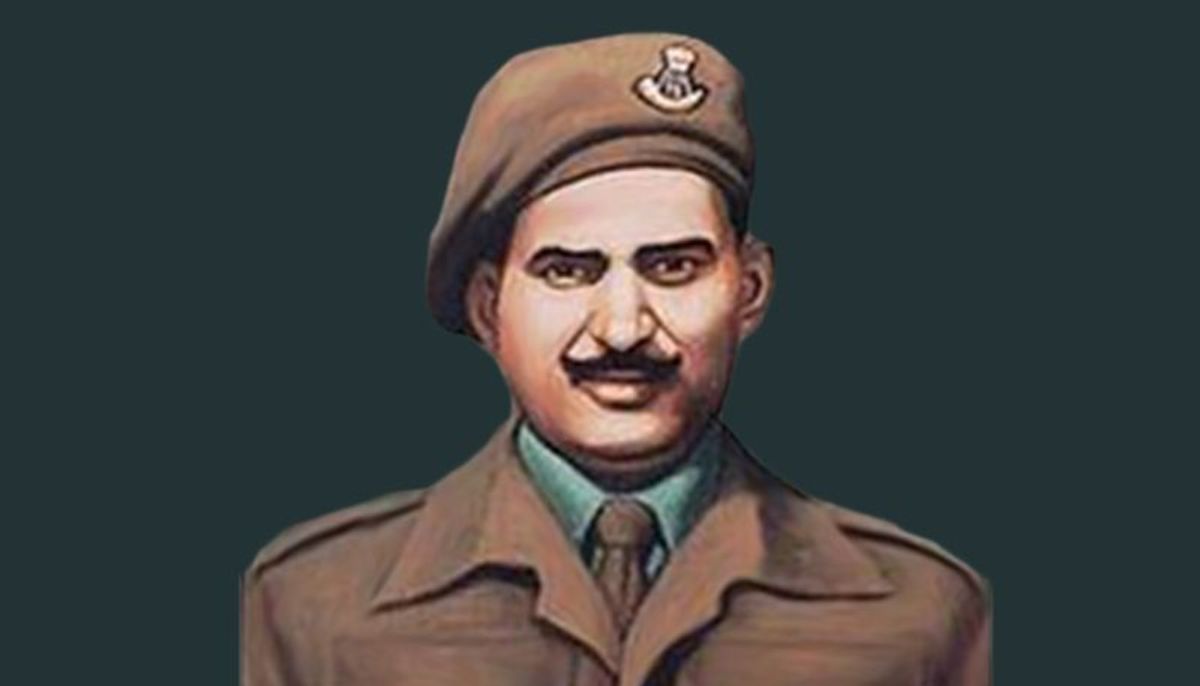
Rajputana Rifles still remembers the valour of Company Havaldar Major (CHM) Piru Singh Shekhawat who gave his life to save Kashmir. Piru Singh fought till his last breath and brought Pakistani forces to their knees. He was posthumously awarded the Param Vir Chakra, India’s highest award for valour in the face of the enemy.
Company Havildar Major Piru Singh Shekhawat was born on 20th May 1918 in the village of Rampura Beri in Jhunjhunu district of Rajasthan, into a great Rajput military family that had a long tradition of serving in the Rajputana Rifles. Singh was the youngest son of father Lal Singh. Singh was a school dropout and wanted to join the army since childhood.
Piru Singh Shekhawat was enrolled in the 10th Battalion of the 1st Punjab Regiment on 20 May 1936 at Jhelum. After completion of his training, on 1 May 1937, Singh was posted to the 5th Battalion of the same regiment. Despite his earlier hostility to schooling, Singh took education seriously and passed the Indian Army Class Certificate of Education. After clearing a few other tests, he was promoted to lance naik (lance corporal) on 7 August 1940. During his tenure with the 5th Battalion of the 1st Punjab, he saw action on the North-West Frontier. In March 1941, he was promoted to naik (corporal), and was posted as an instructor to the Punjab Regimental Centre at Jhelum in September. In February 1942, he was promoted to havildar (sergeant). Singh was an outstanding sportsman; he represented his regiment in hockey, basketball and cross-country running at inter-regimental and national level championships. In May 1945, he was promoted to company havildar major (company sergeant major). He served as an instructor until October 1945. After the end of the Second World War, he was sent to Japan as part of the British Commonwealth Occupation Force, where he served until September 1947. Following the partition, Singh was transferred to the 6th Battalion of the Rajputana Rifles.
संवित् सुयश: 12 वीं बोर्ड (वाणिज्य) परिणाम 100% गार्गी 7/9 प्रथम श्रेणी 80% द्वितीय श्रेणी 20%
Operations in Jammu & Kashmir
Following tensions between the newly independent nations of India and Pakistan, war broke out over control of the princely state of Jammu and Kashmir in October 1947, shortly after Singh returned from Japan. In July 1948, Pakistan launched offensive strikes in the Tithwal sector of Jammu and Kashmir, and captured a ring contour on 8 July. This forced the Indian troops stationed in the forward positions across river Kishanganga to retreat. In an attempt to reverse the situation, Singh’s unit, the 6th Battalion of the Rajputana Rifles, was moved from Uri to Tithwal, and was assigned to the 163rd Brigade. The troops took position on the Tithwal bridge The offensive began on 11th July and went on till 15th July. Two companies were sent to secure the features in this area. CHM Piru Singh was commanding the company ‘D’ which was to secure the first feature. On 18 July, the ‘D’ Company launched it first attack at 01:30. The path to the position held by the Pakistani troops was just 1 metre (3 ft 3 in) wide, and deep ravines lay on either side. This narrow path was overlooked by hidden Pakistani bunkers that allowed both observation and clear fields of fire for the defending troops. As they advanced, the Indian company was subjected to heavy shelling from the Pakistanis, and within half an hour the company had recorded fifty-one casualties But he did not lose heart and continued to advance adopting the battle cry, “Raja Ramchandra Ki Jai”
Within half an hour of their advance, more than half of the company was down. CHM Piru Singh was leading the front sector. When the enemy fire rained heavily upon them, CHM Piru Singh advanced ahead to take out the MMG posts. Enemy grenade splinters ripped open his clothes and wounded several parts of his body. Yet, he advanced to eliminate the attackers from the hills. Rushing forward he bayoneted the crew of the enemy MMG and occupied the post. Most of his company had fallen by this time.
Injured and alone, he left the trench and pushed ahead to take out the second MMG post. Along the way, a grenade struck him and half his face was bleeding. His ammunition was spent and he was gravely injured, yet he did not back down. He threw a grenade into a trench of the second post. He bayoneted two men in another trench and thus secured the second MMG post. While emerging from the second post, he was struck in the head with a bullet and was seen dropping over the edge of the enemy trench. But a loud explosion could be heard in the third MMG post, affirming that CHM Piru Singh’s grenade had done its job. CHM Piru Singh fell to his injuries but had bravely and selflessly completed his mission.
For his profound bravery, extreme devotion and self-sacrifice to his motherland, CHM Piru Singh (May 20, 1918 – July 18, 1948) was given the nation’s highest gallantry award, “Param Vir Chakra” posthumously. The story of CHM Piru Singh Shekhawat continues to inspire millions of Indians and he will always be remembered for his lion-heart courage and love for his motherland.
Appreciate this post! I honestly liked the way you broke down “Unforgettable CHM Piru Singh
Shekhawat Param Vir Chakra – Shadwal” — you don’t often find this kind of down-to-earth write-up.
Lately I’ve been digging into similar subjects myself, and I keep a small guide here:
kedibet slot (https://alpinnhotel.com/) Keep it up!