

CHETNA CHAUHAN

Published on 09.07.2020
Amid tension at Indo-China LAC it would be worth to discuss about China’s Boxer Rebellion (1900) and the role of Ganga Risala. Amidst the lofty sand dunes of Thar Desert, Bikaner Maharaja Ganga Singh’s legacy as a military strategist stands resplendent as he displayed exemplary foresight and excellence in military affairs. He was the first Indian to be given the rank of General in the British Army. He founded “Ganga Risala” (mounted cavalry) that played a stellar role in the two world wars. After independence it was merged with 13 Grenadiers Regiment in 1951 and was given the name Ganga-Jaisalmer Risala. Later on, it was made a unit of BSF (Border Security Force).
The state of Bikaner had a long tradition of using soldiers mounted on camels. For instance, in 1465 Rao Bika led a force of 300 sowar (or camel riders) to conquer neighbouring territories. According to ‘Ganga Risala’ the Bikaner Camel Corps (published by Rajasthan State Archives, Bikaner), its origin dates back to 1885 when during the viceroy cum governorship of Lord Dufferin, it was a unit of the Imperial Service troops. It was also known as Bikaner Camel Corps. The recruitment for the same was done from the local provinces/states while the training and periodical inspections were looked after by the British Officers. In case of an emergency, their services were availed by the then government at the top most level. This unit used to fight alongside British-Indian army.
Ganga Risala was founded by Maharaj Ganga Singh (1887-1943) in the year 1889. The Maharaja presented a proposal to the British government to contribute a military unit comprising 500 personnel to the Imperial army. It was accepted by the British authorities. Consequently, ‘Bikaner Camel Corps’ which is also known as “Ganga Risala” was founded.
Ganga Risala participated extensively in many wars and war-time exercises. It fought in China’s Boxer Rebellion (1900), Africa’s Somaliland rebellion (1902-1904), the First World War (1914-1919) and the Second World War (1939-1945).
Boxer Rebellion and Maharaja Ganga Singh
In 1900, in what became known as the Boxer Rebellion (or the Boxer Uprising), a Chinese secret organization called the Society of the Righteous and Harmonious Fists led an uprising in northern China against the spread of Western and Japanese influence there. The rebels, referred to by Westerners as Boxers because they performed physical exercises they believed would make them able to withstand bullets, killed foreigners and Chinese Christians and destroyed foreign property. From June to August, the Boxers besieged the foreign district of Beijing (then called Peking), China’s capital, until an international force that included American troops subdued the uprising. By some estimates, several hundred foreigners and several thousand Chinese Christians were killed during this time. On August 14, after fighting its way through northern China, an international force of approximately 20,000 troops from eight nations (Austria-Hungary, France, Germany, Italy, Japan, Russia, the United Kingdom and the United States) arrived to take Beijing and rescue the foreigners and Chinese Christians. The Boxer Rebellion formally ended with the signing of the Boxer Protocol on September 7, 1901. By terms of the agreement, forts protecting Beijing were to be destroyed, Boxer and Chinese government officials involved in the uprising were to be punished, foreign legations were permitted to station troops in Beijing for their defense, China was prohibited from importing arms for two years and it agreed to pay more than 330 million US Dollars in reparations to the foreign nations involved. The Qing dynasty, established in 1644, was weakened by the Boxer Rebellion. Following an uprising in 1911, the dynasty came to an end and China became a republic in 1912.
Boxer rebellion was the first occasion when Maharaja Ganga Singh and his regiment provided active service after a temporary approval by Lord Curzon. There are mentions to this effect that this ‘Ganga-Risala’ performed very commendably in ‘Boxer-Rebellion’ in China, serving on behalf of the British Empire. Maharaja Ganga Singh was the first Indian king who fought under British flag in a foreign country. He was not only acknowledged for his preparedness and enthusiasm but also given the title of ‘Knight Commander of the Indian Empire’ on behalf of Queen Victoria. He was also felicitated with the China War Medal.
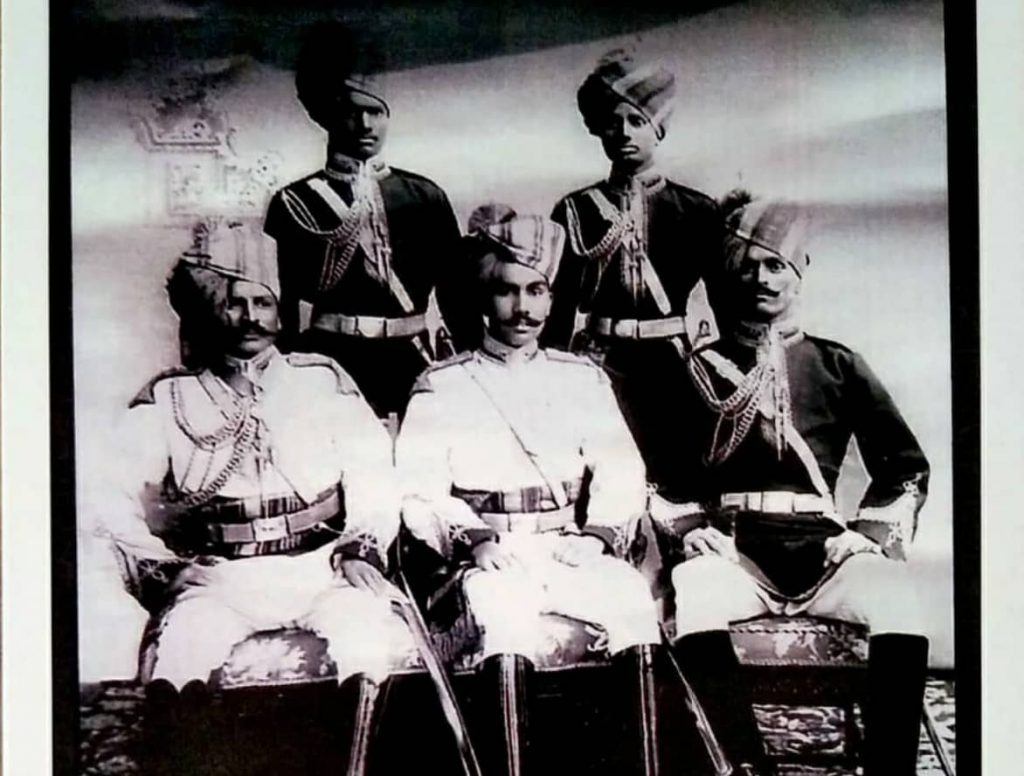
Maharaja Ganga Singh led the Ganga Risala when it fought in the Boxer Rebellion in China in 1900, in Somaliland in 1902-1904 to quell the Somali Uprising and in Egypt in World War I. At the Suez Canal in 1915 the corps routed the opposing Turkish forces in a camel cavalry charge. The Corps fought in the Middle East in World War II, when it was supported by the camel-mounted Bijay Battery, which became a mule team battery.
After India’s Independence the Bikaner Camel Corps was merged with camel troops from Jaisalmer in 1951 to become the Ganga Jaisalmer Risala and joined The Grenadiers as the 13th Battalion. It took part in the actions to foil Pakistani raiders in the Bikaner and Jaisalmer regions during the Indo-Pakistani War of 1965.
After 1975 all of the Indian Military Camel Corps, including the Ganga Jaisalmer Risala, were disbanded. A brief attempt was made to resurrect them but the plan never came to fruition. The Ganga Risala still survives though as a part of the Border Security Force, retaining the name Bikaner Camel Corps. While primarily employed for ceremonial purposes, it is one of the few camel cavalry units still retained by present-day armed forces.
The Ganga Jaisalmer Risala was dismounted in 1974 and underwent conversion into standard infantry. It continues to serve as a regular infantry battalion under the name 13 Grenadiers (Ganga Jaisalmer). Post 1971 the unit has seen action in counter insurgency operations in the states of Punjab and Assam. It has to its credit one Kirti Chakra and one Shaurya Chakra among numerous other awards.