
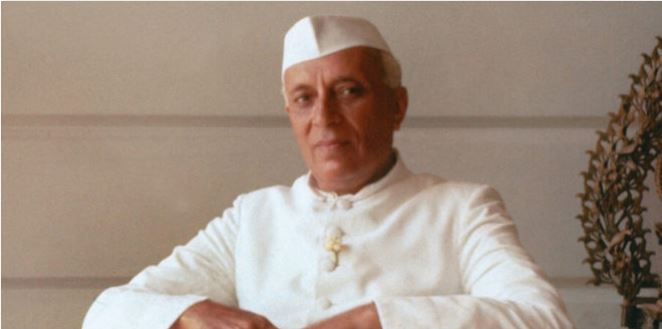
SHADWAL WEB DESK: It is true that Pandit Jawaharlal Nehru (November 14, 1889- May 27, 1964) saw Partition as an inevitable part of India’s independence, but if India emerged a stable democracy, it is in large part due to his leadership, the effects of which are visible even today. Despite the chaos that followed Partition in 1947, general elections were held in India in 1951-52, for the first time and India has continued as a vibrant democracy since. There has been a considerable shift in opinion about Nehru in India. He was idolised by the public while he lived but nowadays there is a tendency to try and actively forget him or diminish his role.
Nehru ensured that his vision of India was inscribed in the Constitution. He drafted and moved in the Constituent Assembly a resolution that set out its objectives, which included the declaration of India as an independent republic in which all power was derived from the people. Everyone was to be guaranteed “social, economic and political justice, equality of status and opportunity, and freedom of thought, religion and association.” They were to be safeguards for minorities, backward and tribal areas. All of this was not provided there. The 1937 provincial elections were limited by property ownership and had given the vote to only about 30 million Indians. There were, by contrast, 173 million eligible voters in the 1951 elections in independent India. Historian Ramachandra Guha writes in ‘Patriots and Partisans’ that “Nehru was without question the chief architect of our democracy. It was he, more than any other nationalist, who promoted universal franchise and the multi-party system.”

Historian Judith M. Brown in ‘Nehru: A Political Life’ writes that “at the heart of Nehru’s vision of India was the conviction that it was a composite nation, born of a civilisation which over centuries had drawn from and assimilated the many religious and cultural traditions present on the subcontinent.” Nehru also worked in a context when India as an independent nation emerged as a political compact where units like princely states and other communities were open to alternative political futures. The Indian Union could hold together based on guaranteed fundamental rights to all, secularism and a state policy that addressed social inequalities and divisions. Nehru instinctively understood the utility of a constitutional democracy for a people with disparate identities; India was also lucky to have a generation of other gifted leaders like B.R. Ambedkar, Vallabhbhai Patel, Maulana Azad and C. Rajagopalachari and together they crafted a political framework for Indians to coexist and evolve a shared imagination of the nation while preserving specific identities.
Nehru’s impact on world politics is widely acknowledged. He emerged as an authoritative voice and critic of racism, imperialism and an advocate of Asian unity, Afro-Asian solidarity and world peace. He presciently crafted the policy of Non-Alignment to steer clear of power blocs in order to benefit from contacts with both sides as Guha points out, and it also enabled India to emerge as a mediator between nations and as a leader of developing countries. Nehru’s conduct of foreign affairs had, as Brown puts it, “created for his country a distinctive, independent international identity.”
Nehru was also focused on domestic social change and saw state planning as a driver of growth and an agent for addressing inequality. This socialist mode of governance with a measure of mixed economy has been discredited in recent years as it stymied innovation and growth but such policies did not lack support – Indian industrialists, for example, also wanted protection from competition. Leaders, in any case, should be judged by the standards of their time. As Brown suggests, Nehru did not have very many governing models to choose from then; he was impressed by the pace of Soviet industrialisation and wanted to replicate it in India without the attendant violence. It’s worth noting where India was setting out from: it’s literacy rate at independence, for instance, stood at 14% and poverty levels were high; state intervention was indeed necessary in several sectors and yielded significant results in many instances, such as in its nuclear and space programmes. Jawaharlal Nehru coined the term ‘scientific temper’; he defines it as an attitude of logical and rational thinking. An individual is considered to have scientific temper if she employs the scientific method when making decisions. Science and technology as we know them became popular in India in the mid-20th century, precipitating socio-economic changes in turn. Researchers and philosophers had anticipated these changes during the independence struggle. Nehru had said:
India must break with much of her past and not allow it to dominate the present. Our lives are encumbered with the dead wood of this past, all that is dead and has served its purpose has to go. But it does not mean a break with, or a forgetting of, the vital and life-giving in that past. We can never forget the ideals that have moved our race, the dreams of the Indian people through the ages., the wisdom of the ancients, the buoyant energy and love of life and nature of our forefathers, their spirit of curiosity and mental adventure. … There is in fact essential incompatibility of all dogmas with science. Scientific temper cannot be nurtured by ignoring the fact that there are major differences between the scientific attitude and the theological and metaphysical attitude; especially in respect of dogma.
Eminent scientists like C.V. Raman, Satyendra Nath Bose, Meghnad Saha and others were also at the frontline of this social revolution. In those days, the Indian Science Congress was an excellent platform for dialogues between the political and the scientific classes, both of which believed that science and its application could effect economic advancement as well as in the national social outlook.
The science policy resolution that Parliament passed in 1958 reflected these sentiments. In 1976, the Government of India reemphasised its commitment to cultivate scientific temper through a constitutional amendment (Article 51A), and setup a nodal agency called the National Council of Science and Technology Communication (NCSTC). But despite these efforts, scientific temper did not permeate through society and didn’t much alter the national psyche.
There is a deep relationship between scientific temper and the idea of secularism, another celebrated facet of our Constitution. The practice of secularism derives strength and support from the ideas of science while the science can best motivate change in a society that appreciates secularism. So the role of scientific temper cannot be overemphasised in a tradition-bound country like India, where dogma and superstations rule the roost.
Nehru’s dream of modern India was dedicating to scientific reasoning and research. India’s most prestigious institutions: the IITs, IIMs, and ISRO’s predecessor, the Atomic Energy Commission and many more are the fruits of his vision.